The Complete Guide to All-Mountain Skiing
All-Mountain: The Ski That Says Yes
One pair of skis. The whole mountain. Understand the range, choose the right model, ski the entire resort.
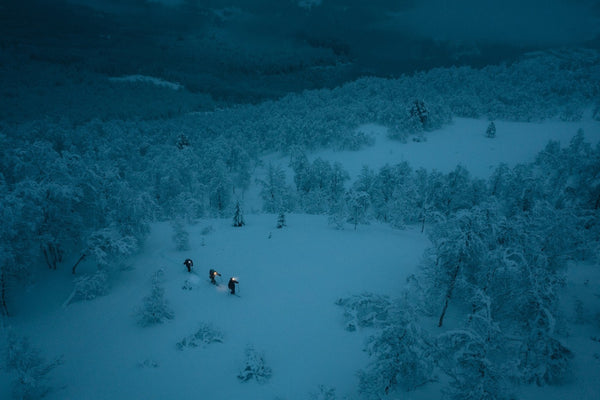
First tracks on the groomed run at opening time. A couloir at the edge of the run before noon. Soft snow in the forest after the break. Back on the groomed run when your legs are getting tired. All of this with the same pair of skis. All-mountain skiing is about refusing to choose. It’s not a compromise. It’s a conviction: the mountain isn’t divided into boxes, and neither should the skis you ride. This guide helps you understand what defines an all-mountain ski, how it differs from a piste ski or a freeride ski, and how to choose the model that matches your skiing style. With the same dedication we put into designing them in Chamonix: the shaper’s precision, the skier’s instinct.
What is all-mountain skiing?
An all-mountain ski is designed to perform in a variety of conditions, from groomed runs to light off-piste, including packed snow, moguls, and the edges of the piste. Its waist width is generally between 80 and 100 mm—narrow enough to grip on hard snow, but wide enough to prevent it from sinking as soon as the snow softens.
It is not a downhill ski. A piste ski is narrow (less than 80 mm), cambered, and designed for pure carving on groomed snow. As soon as you leave the trail, it loses its grip. It’s not a freeride ski either. A freeride ski is wide (more than 100 mm), rockered, and designed for powder and unmarked terrain. On hard-packed slopes, it lacks precision. The all-mountain ski falls somewhere in between. It’s the ski that turns the entire resort into a playground (pistes, off-piste areas, forests, accessible backcountry) with a single setup. It’s also the most versatile ski in your quiver if you have several—the one you grab on days when you don’t know what the mountain has in store.
Who is all-mountain skiing for?
The on-piste skier who wants to expand their horizons.
You’re a solid on-piste skier, you’ve mastered the parallel turn, and you’re starting to get bored on groomed runs. You want to be able to keep up with your friends in the powder along the edge of the piste without feeling unsafe. You’re looking for a ski that gives you confidence everywhere, not just where the snowcat has been.
The experienced skier who refuses to specialize.
You could have three pairs of skis. You’d rather have one that does it all. You want to ski fast on the groomed runs, head off-piste when the opportunity arises, and handle variable conditions without a second thought. One ski, one day, no questions asked.
The creative skier who sees everything as a playground.
Jumps, bumps, skids, aggressive carving followed by a quick pivot: you don’t ski a set line—you invent your own. You want a responsive, playful ski that reacts to whatever you throw at it without imposing a specific style.

How to Choose All-Mountain Skis
The choice is based primarily on four factors. Each one influences the ski's performance in a different way.
Ski width at the waist
This is the parameter that defines the ski’s profile.
From 80 to 88 mm, you’re in the piste-oriented all-mountain range. The ski grips firmly on hard snow, accelerates out of turns, and carves with precision. It remains comfortable in groomed snow and on moguls. In powder, it reaches its limits.
From 88 to 95 mm, you’re in the heart of the all-mountain range. The ski is narrow enough to carve cleanly, wide enough to float in soft snow. This is where the majority of versatile all-mountain skis fall.
From 95 to 100 mm, you’re shifting toward freeride-oriented all-mountain. More float, more forgiveness on uneven snow, but a little less bite on hard-packed slopes. This is the all-mountain ski that never says no.
The profile: camber and rocker
Camber is the natural upward curve of the ski when it’s laid flat. The more pronounced the camber, the more the ski grips on hard snow and the more it launches you out of turns. This is the profile of a pure carving ski; the ski is constantly under tension, ready to bite.
Rocker is the opposite curvature at the tip and tail—the part of the ski that isn’t in direct contact with the snow when the ski is laid flat. It facilitates pivoting, float in powder, and forgiveness on uneven snow.
A piste-oriented all-mountain ski will have a pronounced camber with slight rockers. A playful all-mountain ski will have a medium camber with a pronounced double rocker; less pure grip, more freedom of movement.
Flex
A stiffflex provides stability at speed and precision in turns. The ski doesn’t flex when you load it; it holds firm and responds. This is the flex for skiers who love speed and an engaging ride. A medium flex is more forgiving and easier to bend when pivoting. The ski is forgiving, responsive, and adaptable. This is the flex for skiers who like to mix things up.
Construction: the role of Titanal
Titanal is an aluminum alloy used in the construction of high-end skis. Placed as an insert or plate under the binding, it provides three key benefits: grip (the ski grips the snow during deep turns), stability (the ski doesn’t vibrate at high speeds), and energy return (the ski returns the force you apply as you exit a turn).
An all-mountain ski with titanal performs differently from one without it. It’s more precise, more stable, and more predictable at high speeds. On the other hand, it’s less playful and less forgiving at low speeds. This construction choice is suited to a specific type of skier: one who pushes hard, takes risks, and wants to feel the snow respond.


AROC
Alpine Precision
New to the lineup. The AROC is an all-mountain ski with an alpine feel. Its robust construction, reinforced by a Titanal insert underfoot, ensures flawless grip and stability. Pronounced camber, stiff flex, and stiff torsion. This ski is designed for confident, powerful carving—the kind of ski where every turn is a clean arc and every rebound is immediate. Its subtle rockers leave the door open for forays into variable snow conditions.
Waist width: 85.5 to 87 mm depending on size. Medium turning radius. Available in 153, 160, 166, 173, 178, and 185 cm.
For whom: skiers with a background in carving or competition who want an all-mountain resort ski without sacrificing the grip and precision they’re used to.


MATA
Le carving explosif
90 mm at the tip. Asymmetrical design. Titanal plate on a Heavy Duty construction. The MATA Ti takes carving fun to the next level. Its medium camber and medium flex make it more accessible than the AROC; less demanding when entering turns, more playful when exiting. But the Titanal is there, and it makes its presence known as soon as you apply pressure: the grip holds, the energy returns, and the ski accelerates. Its short radius makes every tight turn accessible and every sequence of turns fluid.
Available in 154, 160, 167, 173, 178, and 183 cm.
For whom: the all-mountain skier who wants fun and powerful carving, with enough width to never feel limited when snow conditions change. Men and women; the size range accommodates all body types.


SLAP 92
The Playground
92 mm at the waist. Double rocker. Medium flex. Adaptive Pivot Control. The SLAP 92 is the freest all-mountain ski in the lineup. No Titanal here. The focus is different: playfulness, creativity, and responsiveness when pivoting. Carving, jumps, skidding, sharp turns—this ski handles whatever you throw at it. Its double rocker makes it forgiving in uneven snow and playful as soon as you let go of the brakes.
From 1,550 g (160 cm) to 1,820 g (185 cm). Available in 160, 166, 173, 178, and 185 cm.
Who it’s for: the skier who gets bored at the resort and wants to turn every run into a session. The one who sees a low wall as a jump, a bump as a springboard, and the slope as a starting point.
How to Choose Your Size
For all-mountain skiing, ski length depends more on your skiing style than on your body type alone. If you prioritize responsiveness, maneuverability, and tight turns, choose your standard length or 5 cm shorter. The ski turns more easily, responds faster, and is more forgiving of timing mistakes. If you prioritize stability at speed and wide turns, choose your standard length or 5 cm longer. The ski provides more support, smooths out bumps, and stays stable when you accelerate. The AROC and MATA Ti are available in lengths from 153 to 185 cm, suitable for both men and women. The SLAP 92 is available from 160 to 185 cm.
→ Internal link: All-Mountain Ski Size Guide
All-Mountain Bindings
In all-mountain skiing, there are no weight restrictions on the ascent; you use the lifts to get up the mountain. Classic alpine Binding s are the standard. What matters is the DIN range (suited to your weight and skill level), the support during the descent, and the reliability of the release in the event of a fall.
For an intermediate all-mountain skier, a DIN range of 4–12 more than covers your needs. For a powerful or aggressive skier, Bindings s rated up to DIN 14 or 16 provide the necessary margin of safety.
If you want to keep the option of occasionally skinning with your all-mountain skis, hybrid “ Bindings ” (such as the Salomon Shift) combine an alpine toe piece with a touring system. They’re heavier than a Touring “ Binding ,” but they offer true alpine support on the descent—the best of both worlds in a single setup.
The whole mountain, just one ski
All-mountain skiing is about adapting to the day as it unfolds. On the trail when the resort opens, along the edge of the trail at noon, in the forest at 3 p.m., and carving the last line on the groomed run at sunset. You don’t change your skis.
You change terrain. And the skis adapt.
We design every model in Chamonix with this idea in mind: the shape you have under your feet determines the sensation the mountain gives you in return. Find the right shape, and every turn becomes a response.
→ All-Mountain Ski Collection
→
Freeride Ski Guide → Equipment Collection