The Complete Guide to Sealskins


Your skins make all the difference
Ski Touring means climbing under your own power. And it’s not just your legs that get you up there—it’s your skins. Two strips of fabric glued to the bottom of your skis. Nothing spectacular to look at. But you’ll feel the difference between a well-chosen pair of skins and an ill-fitting pair within the first hundred meters of elevation gain. In the glide. In the grip. In the energy you have left when you reach the top.
This guide covers everything you need to know about choosing your climbing skins, understanding the materials, caring for the adhesive, and making your gear last. Because we approach climbing skins the same way we approach skis: with the precision of a shaper and the high standards of a skier.
WHAT IS A "SEAL SKIN"?
The name “seal skin” is a historical legacy. The first skins used for climbing slopes were indeed made of seal skin, whose unidirectional fur allowed skiers to glide forward while preventing backward slippage. This has not been the case for decades. Modern skins are made of synthetic fibers or mohair (angora goat hair), but the name has stuck.
The principle hasn't changed. A climbing skin is a strip of fabric with oriented fibers, attached to the underside of the ski using an adhesive and/or clips. When you push the ski forward, the fibers lie flat and the ski glides. When you push backward, the fibers stand up and grip the snow. It is this simple mechanism that makes ski Touring ascents Touring .
At the top of the climb, you remove the skins, fold them up, stow them in your backpack or jacket, and switch the Bindings downhill mode. The transition takes a few minutes. It’s a routine that becomes second nature after a few outings.
Materials: mohair, nylon, and a blend
The velour on a seal skin—the surface that comes into contact with the snow—can be made from three types of fibers. Each material has its own strengths and limitations. The choice depends on your riding style.

Mohair
Mohair is a natural fiber from the Angora goat. It is the traditional material used for Touring skins Touring remains the gold standard for glide performance. Its soft, fine fibers offer an excellent balance between grip and smoothness of movement. On cold, hard snow, a 100% mohair skin glides noticeably better than a synthetic skin.
The downside: durability. Mohair wears out faster than nylon and is less resistant to repeated exposure to wet conditions.

Nylon (synthetic)
Synthetic nylon fibers are thicker, rougher, and more durable. They offer superior grip in wet conditions and on crusted snow. The downside: they don’t glide as well as mohair, which is noticeable on long, gently sloping sections and traverses.
100% nylon skins are rare today, but the material is widely used in hybrid skins.

Mohair/Nylon Blend
This is the industry standard and the choice ZAG has made for its entire line of skins. The blend combines the glide of mohair with the durability and grip of nylon. The proportions vary by manufacturer.
ZAG skins, manufactured by POMOCA, use a 70% mohair / 30% nylon ratio—a blend that prioritizes glide while ensuring longevity.
Seal Skin Glue
The adhesive is what keeps the skins attached to the ski. It’s also the part that wears out the fastest if you don’t take care of it. Understanding how it works will help you extend the life of your skins.
HOW DOES IT WORK?
Modern skins use a pressure-sensitive acrylic adhesive. It adheres to the base ski simply through contact, without heat or chemical activation. The system is designed to be repositionable: you stick it on, peel it off, and stick it back on hundreds of times over the life of a skin.
WHAT DAMAGES THE ADHESIVE
Moisture is the number one enemy. A stored skin that’s damp loses its adhesive strength within a few weeks. Heat accelerates aging: never leave your skins in a car in the sun or near a radiator. Dust, hair, and fabric fibers that stick to the adhesive surface also gradually reduce adhesion.
WHEN AND HOW TO RE-GLUE
When the skin no longer adheres properly to the ski (air bubbles, edges peeling off mid-ascent, loss of grip in cold weather), it’s time to re-glue. The process involves removing the old adhesive (using a low-temperature iron or a suitable solvent) and then applying a new layer of ski skin adhesive. Several manufacturers offer re-adhesion kits. This is a procedure that requires precision, but it extends the life of the skins by several seasons.


How to Choose Your Ski Skins
WIDTH
The widthof the skin must match the width of the ski’s base. If it’s too narrow, the skin won’t cover the entire base grip will be compromised. If it’s too wide, it will extend beyond the edges and interfere with glide.
The ideal fit: a skin that covers the base , leaving 1 to 2 mm of edge visible on each side to maintain lateral grip on side-slopes. ZAG skins are laser-cut to match the exact shape of each ski; the width is optimized along the entire length of the base, not just at the waist.
LENGTH
The skins must cover the entire base, from the tip to the tail. Pre-cut skins for a specific ski model are calibrated to fit exactly. Universal (trim-to-fit) skins are shipped wider and longer, and you cut them yourself using the cutting tool provided.
SPECIFIC SKINS VS. UNIVERSAL SKINS
Specific skins are factory-cut for a specific ski model. The cut follows the shape of the ski, installation is immediate, and the result is optimal. This is the simplest and most effective choice.Universal skins offer more flexibility; a single pair can fit multiple skis. But cutting them to size by hand requires a bit of care.
THE Binding SYSTEM
In addition to the adhesive, most skins are equipped with a tip clip (a hook that attaches to the tip of the ski) and sometimes a tail clip. The clip provides extra security: even if the adhesive loses its hold during the ascent, the skin stays in place.
ZAG Skins
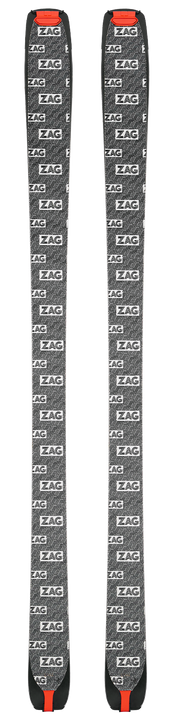
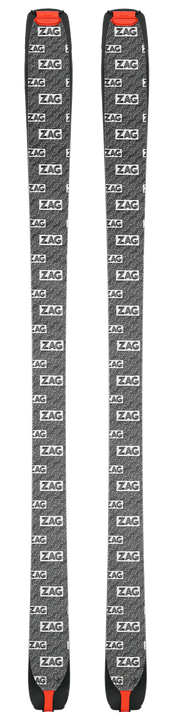
You choose your skins the same way you choose the wood for a ski core: the material determines the feel. All ZAG skins are manufactured by the Swiss industry leader, which has been setting the standard in this field for over 80 years. The composition is the same across the entire line: 70% mohair / 30% nylon, with POMOCA adhesive. Each model is pre-cut to match the exact shape of the ski it’s designed for; the same form-and-function approach as in our skis.
PRO LINE (WHITE)
The performance model, an evolution of the famous CLIMB PRO GLIDE. This is the skin for regular users and challenging outings. Best glide in its class for mixed skins, industry-leading anti-clumping treatment, and high durability. Designed to handle all types of terrain encountered during multi-day mountain expeditions.
CLASSIC LINE (BLACK)
The reliable entry-level model. Same high-quality velvet as the Pro, with a simplified membrane and adhesive system. Lightweight, practical, and easy to handle. Designed for the casual skier looking for a sturdy, affordable product without overcomplicating things.
AVAILABLE MODELS
ZAG skins are available in versions specific to each UBAC model, pre-cut for a perfect fit. A 125 mm “Ready to Climb” model is also available for the wider skis in the SLAP line.
Maintenance and Storage
Properly cared-for hides will last for several seasons. Hides that are stored improperly may need to be thrown away within a few months. Care is simple, but it shouldn't be neglected.
AFTER EACH OUTING
Let the skins dry at room temperature, with the adhesive exposed to the open air. Do not place them on a radiator, and do not leave them in a damp bag. It takes a few hours for them to dry completely. This is the most important step for preserving the adhesive.
STORAGE BETWEEN OUTINGS
Store them flat or hung up in a dry, temperate place. Avoid uninsulated garages in the summer: heat softens the adhesive and accelerates its deterioration.
LONG-TERM STORAGE (OFF-SEASON)
At the end of the season, dry the skins completely, check the condition of the adhesive, and remove any debris (pine needles, small pebbles). Store them flat with the protective net in a cool, dry place. Some skiers glue the skins to the base skis for off-season storage; this works, provided the storage location is suitable.
SIGNS THAT IT’S TIME TO REPLACE THEM
Persistent loss of grip despite re-gluing. Worn-out, flattened suede; crushed fibers that no longer spring back. Tears or delamination. Grip that no longer holds on moderate slopes. When skins show these symptoms, they are no longer fulfilling their purpose and it’s time to replace them.
SNOW BUILD-UP: UNDERSTANDING AND PREVENTINGIT
Snowbuild-upoccurs when snow accumulates under the skins, forming a compact clump that prevents any glide. It’s one of the most frustrating problems in ski Touring. You make less and less progress, you glide worse and worse, and the weight under your feet increases with every step.
WHY IT HAPPENS
Snow packing occurs mainly around 0°C, when the snow is wet. The water in the snow melts upon contact with the skin, then refreezes immediately, creating a layer of ice that traps more and more snow. This is a mechanical phenomenon linked to conditions, not a equipment defect; however, some skins resist it better than others.
HOW TO AVOID IT
The anti-caking treatment integrated into the fleece is the first line of defense. ZAG POMOCA Pro skins feature a built-in anti-caking treatment that significantly reduces this phenomenon. As a supplement, you can apply an anti-caking spray or wax before heading out; this is particularly useful in the spring and in mild weather. In the field: if caking begins, remove the skins, scrape off the accumulated snow, reapply wax, and set off again. Some skiers carry a plastic scraper in their pack for this very reason.
The Essentials
Good sealskins—carefully chosen and well-maintained—make for a smooth climb. Less energy wasted fighting the slip. Less frustration on traverses. More energy when you reach the top. And more energy at the top means more fun on the descent.
It's an unassuming piece of equipment. But it's the one that connects you to the slope—the one that turns your effort into movement.