Touring Skis
Touring Skis
Shaped to roam.
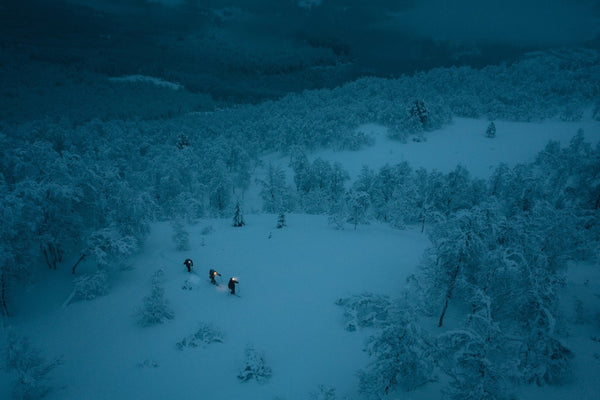
After a two-hour climb, you take off your skins s in the silence of the mountains. All around you lies an untouched expanse. We design these skis to combine lightness on the ascent with true alpine performance on the descent. The playground begins where the lifts end.
4 articles
Filters
Filters applied: 0


Light means far.
Light enough to go anywhere.
Every gram is weighed, discussed, and optimized. In the Shape series, we explain these structural trade-offs. We show how a Touring ski remains extremely lightweight on the ascent without sacrificing its performance on the descent—by balancing what we eliminate with what we preserve.
Made for the open mountain.
Touring ’s skis open up access to the mountain’s unspoiled slopes. As you leave the crowds behind, a sense of calm settles in and the vast open spaces take center stage. We design these skis to cover kilometers on the ascent while delivering flawless grip on virgin slopes. Lightweight construction truly comes into its own when it allows you to go higher, farther, and deeper into the mountains. Our models are built to support your most ambitious adventures.
What is " Touring" skiing?
Climb up the mountain on skis using “ skins ” attached to the soles of your boots, then ski down freely once the “ skins ” are removed. No ski lifts: the skier provides the power. The “ Bindings ” feature a free-heel walking mode and a locked-heel downhill mode.
Climb up the mountain on skis using “ skins ” attached to the soles of your boots, then ski down freely once the “ skins ” are removed. No ski lifts: the skier provides the power. The “ Bindings ” feature a free-heel walking mode and a locked-heel downhill mode.
Do you need to be an advanced skier to start Touring ing?
No. If you can ski a red run comfortably, you have the technical skills. The challenge lies elsewhere: physical fitness—since the ascent requires sustained cardiovascular effort—and knowledge of the mountain environment: reading the terrain, weather, and safety.
Which UBAC should you choose?
UBAC 89 for going the distance: the lightest, most responsive, and most precise in turns. UBAC 95 so you don’t have to choose between ascents and descents: the most versatile model in the line. UBAC 102 when the descent takes priority: low camber, pronounced double rocker, freerando-oriented. UBAC 110 for powder days: the same DNA as the 102, pushed to the limit in width.
What is the width of the base on a " Touring " ski?
Under 90 mm: a ski designed for ascents and classic Touring ; lightweight and effective on hard snow and during traverses. Between 90 and 100 mm: a versatile option, narrow enough to follow existing tracks without extra effort. Over 100 mm: freerando; this ski is geared toward descents and requires more effort on the ascent.
What weight should you aim for in a ski for the " Touring " event?
In the all- Touring , a ski typically weighs between 1,100 and 1,500 g per ski: this is the range of the UBAC line. Below that are the ultralight models, another line focused almost exclusively on climbing performance. Above 1,500 g, we enter the realm of freerando models, which are more stable on the descent but more demanding on the climb.
What size Touring skis should you choose?
For classic Touring ing (UBAC 89 and 95), choose your usual size or 5 cm smaller. For freerando (UBAC 102 and 110), choose your usual size or 5 cm larger for more lift and stability at higher speeds. Feel free to check out our size guide on each product page.
What is the " Binding " for a ZAG " Touring " ski?
An insert- Binding , the current standard in the Touring. ZAG offers the FORGE[Tour] (DIN 4-10, 91, 97, and 102 mm brakes) for efficient Touring , and the FORGE[Pro] (DIN 3-11, 91, 97, 102, and 108 mm brakes) for demanding freerando. Both models were developed in collaboration with ATK in Italy.
Are the skins s included with the skis?
skins s are not included with UBAC skis, but you can add them to your package at the time of purchase or buy them separately here