The Complete Guide to Skiing in Touring
Touring Skiing: The Mountains in Their Purest Form
Everything you need to know to choose your gear, understand the sport, and head out into the mountains.
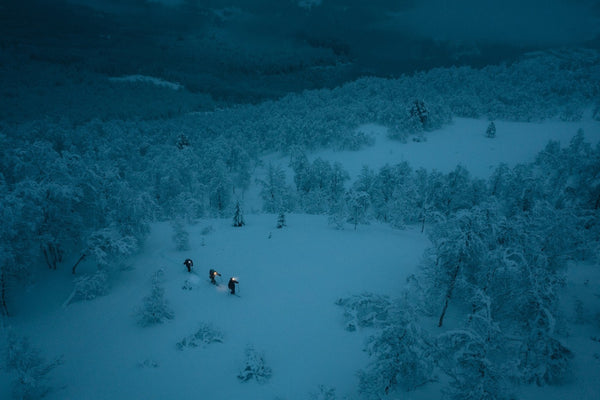
There comes a moment when everything changes. You leave the trail. The ski lifts disappear behind you. All that remains is the sound of your skins on the snow, your breath, and the mountain opening up before you. That’s what ski- Touring is all about. Climbing under your own power. Choosing your own line. Skiing down where no one has gone before.
You don’t need to be a seasoned mountaineer. You don’t need to have been skiing your whole life. Touring ’s ski experience is for anyone looking for something different: direct contact with the terrain, an effort that gives meaning to every turn. And gear designed for that purpose: each ski embodies a shape, an intention, a way of interpreting the mountain. This guide helps you understand the sport, choose the right gear, and set out safely with the right equipment.
What is "skitouring" ?
Touring, or Touring, involves ascending a mountain on skis using seal- skins s attached to the soles, then descending using free-skiing once the skins s are removed. Unlike traditional alpine skiing, there are no ski lifts. The skier provides the power for the ascent.
Touring ski equipment is designed to meet this dual requirement: being lightweight on the ascent and high-performance on the descent. The Bindings feature a walking mode (free heel) and a downhill mode (locked heel). The skis are lighter than alpine skis, with constructions optimized to reduce weight without sacrificing stability.
The sport encompasses several approaches. Classic “ Touring ” prioritizes efficiency on the ascent and lightweight gear. “Freerando”—a term coined in the 2010s with the arrival of wide, lightweight skis like the ZAG UBAC—combines an “ skins ” ascent with a freeride-oriented descent on wider, more playful skis.

Who is “ Touring ” skiing for?
Touring skiing isn’t just for experts. If you can ski red runs comfortably, you have the technical skills to get started in Touring skiing. The challenges lie elsewhere: physical fitness (the ascent requires sustained cardiovascular effort) and knowledge of the mountain environment (reading the terrain, weather, safety).
Beginners in backcountry ski Touring ingare looking for forgiving, easy-to-handle gear that inspires confidence from their very first off-piste turns. A ski with a good balance of weight and stability and an accessible flex.
The regular ski tourer wants a versatile ski that performs equally well in light powder and on groomed snow. They’re looking for a smart compromise between ascents and descents.
The freerider making the switch to the “ Touring ”refuses to sacrifice the thrill of the descent. They want a wide, playful ski capable of floating in deep snow while remaining light enough to carve clean turns.
How to Choose Your Skis Touring
Choosing a ski for " Touring " depends on a few key factors. Each one directly affects how the ski feels on the ascent and the descent.
Ski width
Thisis the measurement, in millimeters, of the narrowest part of the ski, under the foot. It determines the ski’s overall performance.
- Below 90 mm, you’re on a ski designed for ascents and classic Touring : lightweight, responsive, and efficient on hard snow and during turns. This is the domain of lightweight Touring skiing in the strictest sense.
- Between 90 and 100 mm, you’re in the all-around category. The ski remains narrow enough to follow existing tracks without extra effort, while offering enough float in soft snow. This is what’s known as a versatile Touring ski. Beyond that, the ski often exceeds the width of a classic Touring track; each step requires a little more effort.
- Above 100 mm, you’re entering the freerando category. These skis are designed primarily for downhill skiing. They float in powder, handle speed well, but require more effort on the ascent.
Weight
Intheversatile classic- Touring , a ski typically weighs around 1,100 to 1,300 g per ski. This is the weight range for models that combine efficiency on the ascent with a true sense of excitement on the descent—which is where the UBAC line fits in.
Note: the ultra-lightweight category exists below this (skis weighing 700 g or less), but that’s a different story, focused almost exclusively on performance on the ascent. Above 1,500 g, you enter the realm of freerando models, which are more stable on the descent but more demanding on the ascent. Above 1,500 g, you enter the realm of freerando models, which are more stable on the descent but more demanding on the ascent.
The right balance depends on your skiing style. If you spend 80% of your time climbing and 20% descending, weight is the top priority. If it’s the other way around, stability and width take precedence.
Profile: camber and rocker
Camber is the natural upward curve of the ski when it’s laid flat. It provides grip on hard snow and helps you regain speed when turning. Rocker is the opposite curvature, at the tip and/or tail: it’s the part of the ski that isn’t in direct contact with the snow when the ski is laid flat. This raised section facilitates pivoting, float in powder, and forgiveness on uneven snow.
A classic cross- Touring ski will have a pronounced camber with slight rockers: stability and grip.
A freerando ski will have reduced camber and generous rockers: playfulness and lift.
Flex
Flex determines the ski’s stiffness in the longitudinal direction. A stiff flex provides stability at high speeds and precision in turns. A medium flex is more forgiving, easier to bend during pivots, and more playful. For a beginner in ski Touring, a medium flex is often more suitable.


UBAC 89
The Explorer
89 mm at the waist. The lightest in the line: 1,150 g in the 155 cm size, 1,400 g in the 183 cm size. Medium camber, slight double rocker, stiff flex. This is the ski for those who love to tackle steep slopes and for whom the climb is part of the fun. Solid grip on hard snow, maneuverability during turns, and surprising stability for its weight. Available in sizes 155, 162, 169, 176, and 183 cm.


UBAC 95
The Swiss Army Knife
95 mm at the tip. From 1,240 g (158 cm) to 1,490 g (185 cm). Same profile as the 89; medium camber, slight double rocker, stiff flex—but 6 mm of extra width that makes all the difference in soft snow. This is the quintessential versatile “ Touring ” ski: just as at home on technical ascents as it is on descents in variable conditions. Available in lengths of 158, 166, 173, 178, and 185 cm.


UBAC 102
Freerando
102 mm at the waist. From 1,420 g (168 cm) to 1,690 g (188 cm). Here, the profile changes: low camber, pronounced double rocker, stiff flex. The ski is clearly geared toward downhill skiing. Its generous rockers open the door to performance in powder and variable snow conditions. A direct, playful ski designed for demanding skiers who climb to descend. Sizes: 168, 175, 181, 188 cm.


UBAC 110
The Storm Weapon
110 mm at the waist. From 1,640 g (173 cm) to 1,740 g (188 cm). Same DNA as the 102; low camber, double rocker, stiff flex, pushed to the limit in width. This ski is made for powder days. Acceleration, fluidity, and absolute float. Because powder days are rare and deserve to be enjoyed with the right gear. Sizes: 173, 180, 188 cm.
Ski " Bindings " from Touring
Touring 's ski Binding has a feature that alpine Binding s don't: it releases the heel during the ascent to allow for a natural walking motion, then locks it in place during the descent to provide support comparable to that of alpine skiing.
It's the interface between your body and the ski. The quality of this connection determines how you feel in every turn.
Binding systems
Bindings with inserts (or “pins”)
The lightest system. The boot clips onto two metal pins at the front. During the descent, the heel locks into a rear stop. This is the current standard in Touring , used by the majority of riders. The ZAG FORGE[Tour] and FORGE[Pro] Bindings , developed with ATK in Italy, use this system.
Bindings Hybrid models (such as the Salomon Shift or ATK Hy)
These combine a classic alpine toe piece with a walking system. Heavier than the insert-style Bindings , they offer downhill stability closer to that of alpine skis. Suitable for skiers who want a single setup for both resort and off- Touring.
Selection criteria
Weight is a key factor if ascending is your priority. The DIN range should match your weight and skill level: a 4–10 range covers most skiers at Touring, while a 3–11 range offers more leeway for lighter skiers or those seeking a more aggressive ride. For the most powerful skiers or aggressive alpine skiing, Bindings go well beyond that—up to DIN 15 or 16. The width of the brakes must match the waist width of your ski.


Seal- skins
Seal-skin “ skins ” (which haven’t used seal skin for a long time) are strips of fabric that are glued to the bottom of the ski to help with climbing. The fibers, which are oriented in a single direction, allow the skier to glide forward while preventing backward slippage.
Materials
Mohair (Angora goat hair)
The best balance of glide and grip. Lightweight, smooth, and performs excellently on cold snow. Less durable than synthetic materials.
Nylon (synthetic)
Very durable and good grip in wet conditions. Glide is inferior to mohair.
Mohair/nylon blend
The industry standard. Combines the glide of mohair with the durability of nylon. This is the choice of the ZAG line: POMOCA’s skins , made of 70% mohair and 30% nylon, offer a balance between performance and longevity.
Care Instructions
Allow the skins to dry at room temperature after each use, with the adhesive side exposed to the air. For storage, most skins on the market require a protective mesh between the adhesive sides, but ZAG skins are an exception; their adhesive allows them to be folded directly, skin-to-skin, without a mesh. Store flat or hung up in a dry, temperate place. If adhesion is lost, the adhesive can be reapplied.


ZAG CLASSIC
The reliable entry-level model. Same high-quality suede as the Pro, with a simplified adhesive system and membrane. Lightweight and practical, designed for the casual skier who wants a durable product without overspending.
ZAG " skins " are available in widths of 89, 95, 102, and 110 mm, cut to fit each UBAC model.


Helmets and Safety
In ski- Touring, a helmet must meet specific requirements. It is worn during the ascent, so it must be lightweight and well-ventilated. It provides protection during the descent in off-piste conditions, so it must be certified for skiing. And if the route includes alpine sections, a mountaineering certification is a plus.
THE STEALTH 3NORM ZAG
The STEALTH is triple-certified: EN 1077 (skiing), EN 12492 (mountaineering), and EN 1078 (cycling). It’s a three-in-one helmet. Its DualShell In-Mold construction combines a rigid polycarbonate shell with high-absorption foam, reinforced laterally with ABS. Weight: 350 g in XS-S, 394 g in M and L. 3D adjustment system, adjustable summer/winter lining, removable ear pads, optimized ventilation.
Essential safety gear.
A helmet alone isn’t enough. When skiing off-piste, the trio of avalanche transceiver, shovel, and probe is non-negotiable. You must carry it on every outing, even on routes you know by heart. There’s no such thing as zero risk in the mountains. Knowing how to use your avalanche transceiver is just as important as carrying it: training sessions are organized at the start of every season by clubs and guides.


Ski " Poles " from Touring
In ski- Touring, telescoping Poles s are the standard. They are adjustable in length to suit the ascent (longer on flat terrain, shorter on slopes) and fold up for carrying on a backpack. Fixed Poles s are lighter and stiffer, but less practical to use.
Selection criteria: weight (every gram counts when planting thousands of Pole), the strength of the locking mechanism, the grip of the handle (your hands get sweaty on climbs), and a basket designed for deep snow. An extended grip on the tube is a real plus in Touring : it allows you to reposition your hand lower without changing the adjustment, especially on traverses. This is the case with the ZAG “ Poles .” An adjustable length between 110 and 140 cm accommodates most body types and slopes.
It all starts with a first step
Touring 's skiing isn't just another sport. It's a way of experiencing the mountains. Every run is different. Every climb adds value to the descent. And on certain days, when the snow is good and your body finds its rhythm, everything falls into place. The skis carry you. The terrain responds to you. You come back down a little different. That’s why we’ve been designing skis in the Alps since 2002—for those moments when the shape we’ve given the ski meets the line you carve in the snow.