The Complete Guide to Freeride Skiing
Where the trail ends
Terrain, commitment, sensation: understanding freeriding and choosing the ski that’ll take you there.
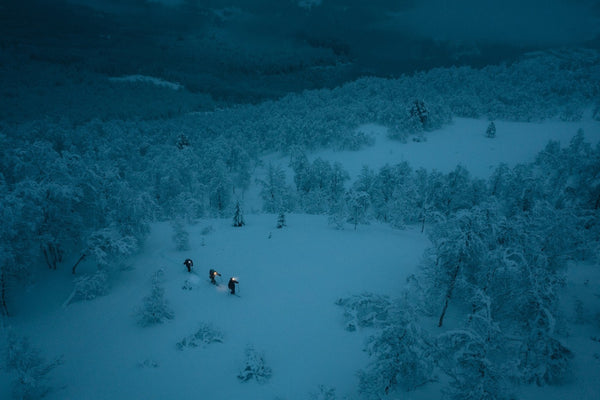
Freeriding begins beyond the marked trails. Where the snow is no longer groomed, where the terrain is no longer safe, where every turn is a decision. The powder explodes beneath your tips. Your body settles into the slope. The sounds change; all that remains is your breath, the whoosh of the snow, and the dull thud of your skis flexing as you exit a turn.
It’s a commitment. The terrain gives as much as it demands. And the skis you have on your feet determine what you can reach—or what will remain out of your reach. This guide helps you understand what defines a freeride ski, what sets it apart from other categories, and how to choose the one that matches your level of commitment.
What is freeride skiing?
Freeriding is skiing in natural, unsecured terrain. Off-piste, forests, couloirs, steep slopes, and vast powder fields. The terrain isn’t groomed, conditions change from one hour to the next, and it’s up to the skier to read the mountain in real time. It’s not all-mountain skiing. All-mountain skiing stays connected to the resort—pistes in the morning, off-piste in the afternoon. Freeriding breaks that connection. Nor is it freerando, which incorporates the ascent via “ skins ” into the equation. Freeride is practiced using the lifts or after short walks to access the terrain; all your energy is focused on the descent. Freeride skis are built for this. Wide (100 mm or more at the waist), rockered, designed to float in powder, handle speed on uneven terrain, and provide the stability you need when you commit to a slope or a couloir.
Who is freeride skiing for?
The all-mountain skier who wants to take it to the next level.
You’re familiar with light off-piste skiing. You’ve already carved your first turns in powder. Now you want to go further: steeper slopes, more challenging conditions, days when the snow is deep and your all-mountain skis reach their limits. You’re looking for a ski that opens up this terrain for you without putting you in danger.
The Powder Hunter.
You live for those big days. When the forecast calls for 40 cm of fresh snow, you drop everything. Those days are rare. They deserve a ski that’s up to the task—a ski that floats, accelerates in deep snow, and turns every turn into pure excitement.
The big-mountain skier.
Speed, steep slopes, technical terrain. You want a ski that can handle 70 km/h on an exposed face without flinching. Stability, inertia, confidence. Here, the ski can’t waver; it has to hold its ground.

How to Choose Freeride Skis?
In freeriding, every technical factor has a direct impact on what you can do on the slope. Here's what matters.
Ski width at the waist
This is the key specification. It determines the ski’s float in deep snow and its overall performance.
From 100 to 105 mm, you’re looking at a versatile freeride ski. It floats in light powder, remains maneuverable in groomed snow, and turns well in the forest. This is the most versatile range; the ski that takes you through all backcountry conditions without limiting you when snow conditions vary.
Beyond 105 mm, you’re in the deep-powder freeride range. Buoyancy increases, wide turns become fluid, and speed in deep snow comes naturally. On the downside, the ski becomes less maneuverable in tight terrain and less precise when the snow hardens. This is the category for days when it’s snowed heavily.
Rocker
In freeriding, this is the most important factor. Rocker—the part of the tip and tail that doesn’t touch the snow when the ski is flat—determines float, forgiveness, and ease of pivoting.
A double rocker (at both tip and tail) is the freeride standard. The rocker tip helps the ski float in powder: instead of sinking, the ski rises and floats. The rocker tail makes it easier to slide and pivot—two essential moves when the terrain narrows or the slope changes abruptly.
The residual camber underfoot remains significant. Even in freeriding, you need grip when the snow hardens; when traversing, on a crusty section, or in a couloir where the snow has been blown away. A 100% rocker ski with no camber slides over hard snow without gripping. A medium camber underfoot maintains that security.
Flex
A mediumflex offers playfulness and pivot. The ski bends easily, responds quickly to changes in direction, and forgives timing mistakes. This is the flex for creative freeriding: forest, varied terrain, and rapid sequences of turns.
A stiff flex provides stability at high speeds. The ski doesn’t flex under pressure; it smooths out bumps and remains composed when everything speeds up. This is the flex for big mountain skiing: open slopes, wide turns, and full commitment.
Weight
In resort freeriding, you don’t climb; you’re going down. Weight isn’t a hindrance on the ascent; it’s a factor in stability. A heavier ski has more inertia: it cuts through bumps without veering off course, it stays planted in crusty snow, and it inspires confidence as speed builds. This isn’t a flaw—it’s a quality—as long as you stick to pure downhill skiing.


SLAP 100
The Versatile Freeride
100 mm at the waist. Medium camber, double rocker, medium flex. Adaptive Pivot Control. From 1,640 g (166 cm) to 1,900 g (187 cm). The SLAP 100 is lightweight and playful for a freeride ski. Its pivot point facilitates an instant transition from carving to freeriding—whether it’s a carved turn, a slide, a jump, or a quick acceleration. Whether in the forest or on open slopes, it handles it all. Its 100 mm width puts it right in the middle: wide enough to float in light powder, narrow enough to stay responsive in variable snow conditions.
Available in 166, 174, 181, and 187 cm.
WHO IT’S FOR: The freerider who wants a responsive ski for all off-piste conditions. Someone who skis in the woods one day, on open slopes the next, and wants the same confidence everywhere.


SLAP 112
Gunpowder weapons
112 mm at the waist. Medium camber, double rocker, medium flex. From 1,970 g (182 cm) to 2,010 g (188 cm). The SLAP 112 is designed with a single goal in mind: absolute float in deep snow. In the forest after a heavy snowfall, in vast powder fields, on slopes where snow accumulates—this ski reaches comfortable cruising speeds where others struggle to stay afloat. Large turns are fluid, acceleration is natural, and the sensation is like surfing a white wave.
Available in 182 and 188 cm.
FOR WHOM: the powder hunter waiting for the big days. The skier who already has an all-mountain ski in their quiver and wants a dedicated weapon for those days when there’s nowhere else to be.
What about the footbridge?
If you’re torn between all-mountain and freeride, the SLAP 92 is worth a look. It’s first and foremost an all-mountain ski: 92 mm at the waist, dual rocker, Adaptive Pivot Control. But its SLAP DNA makes it perfect for fun and freedom on varied terrain. It won’t replace a true freeride ski in 30 cm of powder, but it opens the door to light off-piste skiing without sacrificing the comfort of the trail.
→ SLAP 92
→ All-Mountain Ski Guide
Freeride Bindings
In freeriding, the Binding must provide absolute stability during the descent. The terrain is technical, the forces at play are high, and falls can be violent. The alpine Binding with a high DIN setting is the standard.
For intermediate to advanced freeriders, a DIN range of 5–14 meets their needs. For the most dedicated skiers (big mountain, speed, jumps), Bindings with a DIN setting up to 16 provide the necessary margin to ensure the Binding doesn’t release in the middle of a run.
If you want to retain the option of using a skins to access slopes not served by lifts, hybrid Bindings combine an alpine toe piece with a walking system. They’re heavier than a Binding from Touring, but they provide the same downhill support as an alpine Binding ; no compromises when you’re on the move.
→ Collection Bindings


SEND MIPS
Freeride Safety
As soon as you leave the marked area, the avalanche safety kit—consisting of an avalanche transceiver, shovel, and probe—is mandatory. Not recommended. Mandatory. The risk of an avalanche exists whenever there is unstable snow and a slope. Knowing how to use your avalanche transceiver is just as important as carrying it; that’s what the training sessions at the start of the season are for.
A helmet is non-negotiable. In freeriding, the risks of impact are different from those on the slopes: trees, rocks, and falls on steep slopes. The ZAG SEND MIPS is designed for this terrain; it features MIPS technology to protect against oblique impacts, a hybrid DualShell construction, and Fit3D support.
The terrain sets the pace. Your skis respond.
Freeriding means embracing whatever the mountain has to offer. Deep powder one day, crust the next, an exposed couloir when conditions align. The skis you choose determine what you can go after. They have a shape, a flex, a rocker; and that shape shapes the sensation the mountain gives you in return. We design the SLAP skis in Chamonix, facing the terrain where we test them. Each model is the result of an obsessive cycle of iteration: shape, test, listen to what the ski says on the slope, and start over. Until the shape and the feel become one.
→ Freeride Collection
→ All-Mountain Ski Guide
→ Equipment Collection