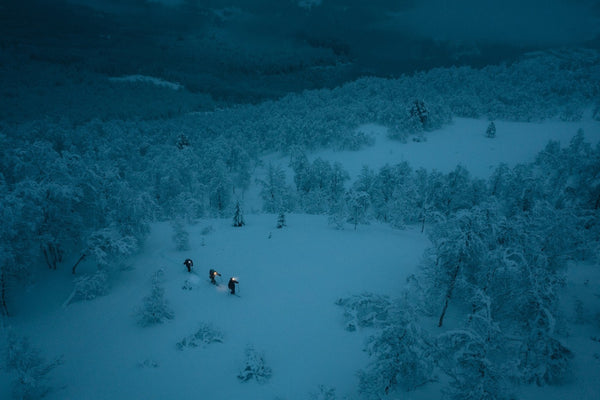
Behind the Scenes
The Saint-Hilaire-du-Touvet ski resort, located in the Chartreuse Mountains, should have closed. A mudslide, a municipal budget stretched to the limit, and dwindling snowfall. Yet it’s still open, thanks to a handful of residents who decided that some things simply shouldn’t be shut down.
Cécile is retired. She used to work at Météo-France. Now she spends her winter weekends at the top of a ski lift, tinkering with the lift’s machinery. Maintenance doesn’t stop on days when the lifts are closed. The towers and machines don’t wait for the season to break down, and no one will come to fix them in her place. She spent her career measuring snow, temperature, and precipitation. She knows the numbers. She knows better than anyone what it means for winter to recede year after year, what the data is worth when it foretells what no one wants to hear. She now devotes her retirement to keeping alive the place where that snow, when it deigns to fall, still has meaning.
This paradox lies at the heart of Saint-Hilaire-du-Touvet. A resort that economic logic has condemned. One that survives through sheer stubbornness. Through the quiet conviction that some things are worth getting your hands dirty for, even when the market has delivered its verdict. Here, we read the verdict, put it away in a drawer, and headed back out onto the slopes. With the tools we had.
Here, determination is quiet. Anonymous. People who get up early on Saturday mornings to keep the lifts running, for no other reason than the certainty that someone has to do it. The simplicity of the act is what makes it unstoppable.
When the Mountain Gives Way
The numbers don’t look promising. Five ski lifts. Seven runs. A 500-meter vertical drop. An elevation of 815 meters—a place where “white gold” is becoming increasingly scarce, where winters are growing milder year after year with a consistency that is no longer climatically insignificant. In December 2021, a torrential mudslide destroyed a large part of the resort. The municipality no longer had the technical or financial means to keep it running. Permanent closure seemed inevitable, irreversible, even reasonable, in the eyes of those who view these matters from their offices.
What happened next isn’t covered in any resort management manuals. Nearly two hundred residents decided to come together. They did their research, complied with regulations, and trained for jobs they hadn’t chosen to do. They took charge of the ticket offices, the slopes, the lifts, and rentals. Some worked a few hours on weekends. Others spent entire days. The most dedicated were there almost constantly, winter and summer alike, when no one was watching and there was neither snow nor visitors to justify the effort.
Together, they keep going what the system had decided to shut down. Just a few miles from the large ski resorts nearby, Saint-Hilaire feels like what skiing used to be before it became an industry. Artisanal. Rooted. Passed down from one generation to the next. Passion, local roots, tradition, resilience. Words we often hear in discussions about the mountains. Here, they describe something specific, everyday, and tangible.
Ten euros to slide
The rental shop is worth a visit. A small room with walls covered in faded posters. A table, a computer, four chairs. And in the back, behind a half-open door, the equipment is lined up with the care one reserves for precious things. Mostly junior skis, with barely a few pairs longer than 160 centimeters. Vintage models that have weathered the decades without a care, along with a few remaining 20th-century designs—narrow, functional, indifferent to trends. Very few recent skis with a waist width exceeding 65 millimeters. The kind of inventory that major chains have long relegated to their basements, yet here it forms the beating heart of the operation.
The park is more than enough. It’s much easier to learn to ski without the bells and whistles of modern skis—without the carbon fiber and wide tips that forgive everything but teach nothing. Ten euros for equipment. Another ten for the ski area, with the pass that the volunteers have dubbed the “smile pass.” Sixty euros for the entire season. The resort is open only on weekends and for one week in February, snow permitting. The school slope is equipped with snow cannons, the only luxury the resort allows itself, the only concession to technical modernity.
The smell of hot wax in the rental shop. The metallic clang of Bindings clipped onto boots Bindings are too big for feet that are too small. The line at the counter, kids who can’t sit still, adults who know exactly where they’re going. These details don’t appear in any report on the future of local skiing. Yet they’re all that matters. What’s essential here is always tangible. Always within reach.

An Intimate Geography
They are carpenters, computer scientists, roofers, retirees. They slid before they walked. They discovered green, blue, and red before any other colors. They spent their childhoods at Pierre Dorée, Les Gélinottes, and La Combe. These names resonated in their childhood as intimate places, foundational landmarks, promises of high altitudes kept every winter weekend. A cable, poles, and the slopes of a forest that constituted, for an entire generation, the expanse of the skiable and desirable world.
They are defending something older than the economy, something less quantifiable than revenue. The right to pass on to their own children what skiing means, right where they themselves learned it. What this transmission entails in concrete terms: freezing mornings on the ski lifts, hours of unseen volunteer work, a craft learned later in life. Things that don’t appear on any balance sheet and yet endure, weekend after weekend, season after season.
The satisfaction of giving it your all to defend a territory isn’t measured in hours spent. You can see it on their faces. You can hear it in the way they talk about their trails, with the precision of those who know every turn, every bump, every patch of ice that reappears in the same spot every January. A physical knowledge, passed down through practice and example, that cannot be found anywhere else at this price. Or at any price.
The Paradox of Large Resorts
Saint-Hilaire exists in the shadow of something. Skiing, as the industry has shaped it over the past forty years, has been built on a logic of consolidation, expansion, and interconnection. Small resorts have been absorbed, closed, or relegated to the margins. Lift ticket prices have skyrocketed. Facilities have proliferated. For a growing segment of the population, skiing has become a leisure activity out of reach. This trend has a cause. A series of choices that have systematically prioritized growth over tradition, profit over the act itself.
Saint-Hilaire answers with action. People taking turns manning the pylons, staffing the ticket booths on Sunday mornings, learning how to operate the lifts because no one else will. What we find here bears a striking resemblance to what skiing might have remained had the logic of profit not eventually consumed everything. It has no name. It doesn’t need one.
That’s not how the question is framed in Saint-Hilaire. No one talks about alternative models, degrowth, or the future of skiing. We operate the lifts. We repair the towers. We open the ticket booths at nine o’clock and close them when the last skier has come in. Philosophy can wait. The lift, no.
Another world
The last day of the season. The parking lot is full. People recognize each other as they get out of their cars, calling out to one another over the roofs of the cars parked in a herringbone pattern. Children run between the adults. The snow is starting to disappear at the edges of the slopes, revealing patches of yellowed grass that no one seems to want to look at. Their faces wear those genuine smiles. A few pairs of skis made the trip in the trunk of the car. They’ll stay right there, under the feet of a volunteer or a child who’s come to discover skiing for the first time.
Then we set off again. Toward the big resorts, with their day passes, their development plans, and their market studies commissioned at exorbitant prices. Toward skiing as the market has shaped it, optimized it, and priced it down to the bone. The road back down to the valley is long. The Grésivaudan region spreads out below, indifferent. The same snow. Another world.
In the parking lot, just as they were about to leave, a child fell. He got up on his own, without looking back, and headed back toward the trail. That’s exactly why they’re there.
This story is part of Contre-Pente, an original ZAG series that explores the other side of the mountain and ski culture.