THE SKIER WHO DEFIED GRAVITY


After a career-ending crash, Pierre-Yves Leblanc found his way back to the snow, redefining what it means to truly read the mountain. A conversation with a pioneer that traded the rigid gates of ski racing for the absolute freedom of big mountain freeriding.
Big mountain skiing was a different beast in the late 90s. It was raw, unforgiving, and demanded a level of physical commitment that few possessed. Pierre-Yves Leblanc was one of those few. Pioneer of his era, he hurtled down the slope, stiff skis on his feet. Straight down massive lines that would make most hearts pound out of their chests. He pushed the limits of what was possible before the equipment had even caught up to the imagination of the riders.
From a disillusioned ski racer to a fully sponsored pro living the dream in Whistler, Pierre-Yves built a reputation on going huge. But the higher you fly, the harder the landing. During a trip to South America in a lean snow year, a cliff landing went wrong. Fifteen feet was all it took. His body took the first hit. His sponsors followed and brought his professional days to a standstill in the span of a heartbeat.
A conversation with a skier shaped by impact.

You started in the rigid world of ski racing. How did you end up pointing it down big mountains?
P.Y.L. — I had been ski racing all my life, and I just ended up hating it. It was all about restrictions: you can't do this, you can't do that, no fun, no dating, no partying. I finally said, "Fuck ski racing, that sucks." Right after I quit, I went to Costa Rica and met some pro surfers. Every morning at sunrise, they were out hitting waves. I told them they had the ultimate life, and that skiing sucked because it was just going around blue and red gates on ice. They looked at me and said, "What do you mean? Skiing is riding down massive mountains in powder. It's exactly like surfing, you gotta go try it." So I packed my bags, moved to British Columbia, and discovered big mountain skiing.
Big mountain skiing back then was a totally different game. How did the tools dictate the way you rode?
P.Y.L. —Back in the late 90s and 2000s, the skis just weren't quite there yet. Skiing was mostly about straight lines. We couldn't really turn or ski technical features. If I close my eyes and think back to the lines I was skiing back in the day, my heart still pounds. It was so intense. Today, the coolest thing is that I enjoy much more technical lines because the skis maneuver so much better. They slide, we can slash, it’s way more playful. The line of choice today is a playful one, compared to the big, full-send lines of the past.
That passion quickly turned into a professional career. At what point did it all come to a sudden halt?
P.Y.L. — After a few years of competing, I won an event and Atomic called me. They told me to move to Whistler, gave me a salary and a budget to ski full-time, and asked me to quit snowboarding. That wasn’t too hard for me! So I settled in Pemberton and rode full-time. But a few years later, I went to South America for a really bad season. It was barren, but I was skiing at my best. I got caught off guard on a rocky ridge, veered just a tiny bit too far to the right, and landed 5 meters off my intended landing spot. I landed right on the rocks. I thought I was dead. I survived, but it was the end of my career. It happened in September. By November, I had a pin in my femur, no sponsors left, and I had to find a real job.
How do you bounce back from that and rediscover the joy of skiing?
P.Y.L. — It took a while, but ten years later, I was back to 100%. Except now, I have a life too. I have a home, a family, and I’m really happy. Right now, I ski with my kids, and it’s the most fun thing in the world. I can take them to all the spots I know and share that with them. Skiing with them again is the best feeling in the world. Honestly, I have to say it’s almost more fun today than it was back then.
This joy clearly goes hand in hand with a new approach. How do you view the mountains today?
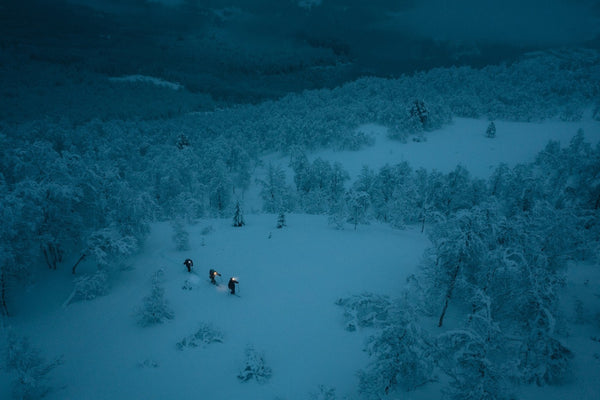
P.Y.L. — When I’m in the mountains with my boys, we try to connect with them, to read the signs they send us. Where is the danger? Where is it safe? Where is the good snow? I treat the mountains like a living being. Their mood changes every day with the light and the snow. Every day, you have to look at it differently. I never go up with a set plan anymore. I go with an idea, but it changes all the time because the mountain tells me: “Look at that, and over here? I’ve got a little cornice over there just begging to be carved.” And I just say to myself: “Oh, that looks pretty good, thanks, mountain.” ” We adapt, we improvise, and we try to become one with the terrain. That’s what I’m trying to teach my kids.
What kind of skis do you use to carve turns?
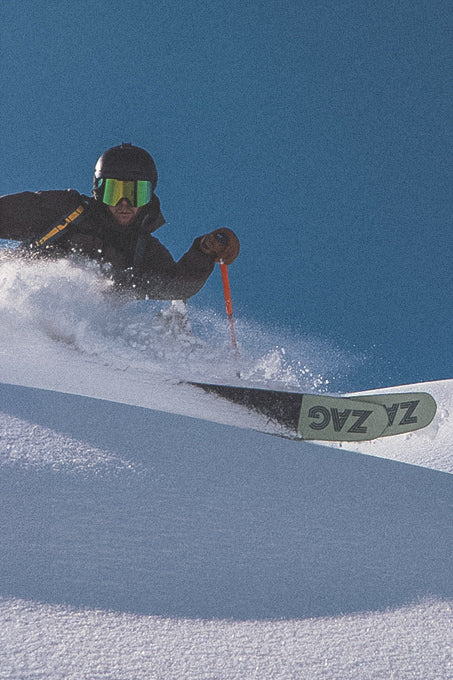
P.Y.L. — I’m riding the Slap 104s right now. Like I was saying earlier, back in the day we had these ultra-stiff skis that you couldn’t do anything with except ride straight. These days, I want to have some fun. The 104s are perfect for that because they’re super maneuverable. They let you slide, pivot super fast, and slash through any terrain the mountain throws your way. Since I never hit the slopes with a specific plan, I need a tool that can instantly adapt to whatever the terrain dictates. This is exactly the one.
This interview is part of One More Line, a mini-series produced by ZAG that follows skiers driven by obsession, documenting how their addiction to the mountains makes them feel alive.