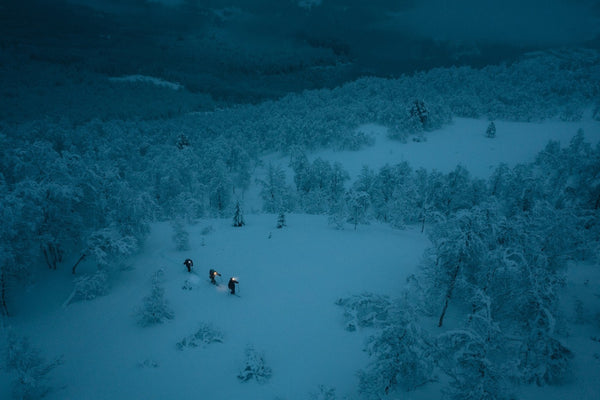
The Art of Skiing


Le ski est une forme d'expression. La montagne devient le support. La manière dont un skieur s'y déplace révèle sa vision du monde.
Some skiers seek architectural precision, treating the slope as a canvas where form and structure converge. Others pursue verticality, seeking terrain where the stakes rise with every meter. Some channel pure energy, operating outside all convention. These are not styles. They are languages. Different ways of articulating the same relationship to gravity, snow, and space.
The artist Greg Podevin collaborated with three ZAG skiers to translate these languages into visual form. He studied the images and observed how Julien Regnier, Mathis Dumas, and Enak Gavaggio moved. He then spoke with each of them.
“The goal was to get to know them as people, beyond just the athletes,” explains Greg. “I learned their language on the snow through video, but I needed to talk to them to really get to know them.”
The result is three portraits that are completely different from one another. Because no two skiers ski in exactly the same way.
Julien Regnier
Julien talks about skiing the way one might talk about architecture. He speaks of volumes, lines, and spatial tensions. A former racer turned ski shaper, he approaches the mountain with a technical precision that serves a single purpose: to reach that moment when control gives way to flow.
“I love architecture,” says Julien. “More than aesthetics or physics, it’s about visual identity. I’m drawn to forms and sculpture, but through the lens of architecture.”
He explores how light interacts with snow and how the choice of lens alters perception. Greg has translated this into a visual form. The portrait depicts fluid movement contained within a rigid structure. Precision meets relaxation.

Mathis Dumas
Mathis skis in terrain where there is no margin for error: steep, exposed high-mountain slopes. It’s mountaineering disguised as skiing. The environment becomes vast and unforgiving. The stakes rise with altitude.
Greg's portrait captures this reality. The composition emphasizes scale. The skier appears small against the mountain. The danger lies in the sheer verticality itself. The work explores what this form of skiing demands: lightweight gear for serious goals. The high mountains serve as the canvas.
The portrait goes beyond glorification and leans toward documentation. This is what the choice of these lines requires.

Enak Gavaggio
Enak Gavaggio brings a whole new energy to the table. A former ski-crosser with a punk sensibility, he shows up with stories ranging from garden gnomes to tattoos, inhabiting a world where instinct leads the way and convention follows.
“I’ve always acted,” says Enak. “I’ve always enjoyed coming up with characters. But at the same time, I stay true to myself. I don’t lose sight of who I am.”
He expresses himself through alter egos. Rancho, his legendary character, blurs the lines between performance and reality. Greg sought to capture this exuberance in all its intensity—someone who operates outside the expected framework. The result channels this energy without filtering it. Heavy metal translated into snow.
One Platform, Three Languages
The three portraits have almost nothing in common visually. Julien’s emphasizes architectural precision. Mathis’s conveys verticality. Enak’s embodies anarchic joy. Yet they go together.
“Beyond their differences,” Greg notes, “they share something fundamental.”
The three skiers use skiing to express something beyond athletic performance. The mountain becomes the medium through which they express themselves. Greg’s portraits document three distinct dialects of the same language. Skiing as an art form. Three artists working on the same canvas in radically different ways.