How to Choose Your Touring , and Freeride Ski Poles


" Pole," that fake detail
Telescopic or fixed, lightweight or sturdy: find the right Pole for your style of skiing.
We spend hours choosing our skis, Bindings, and climbing skins. And we buy our Poles in five minutes. That’s a mistake. The Pole is the point of contact between your body and the mountain when skis alone aren’t enough. On the ascent, it propels you forward. During traverses, it stabilizes you. On the descent, it sets the rhythm for every turn. In freeride, it takes the brunt of whatever the terrain throws at you. An ill-fitting Pole (too heavy, too fragile, poorly adjusted) takes its toll over the course of a full day.
Telescopic or fixed?
That's the first decision you need to make. Both formats exist for good reasons, and each is suited to a different purpose.
The Telescopic " Pole "
The standard in ski- Touring. A telescopic " Pole " can be adjusted in length to adapt to the different phases of the outing: longer on flat terrain and during traverses, shorter on steep slopes, and folded down to its minimum length for carrying on a backpack. It is this versatility that makes it the go-to tool whenever the route involves an ascent.
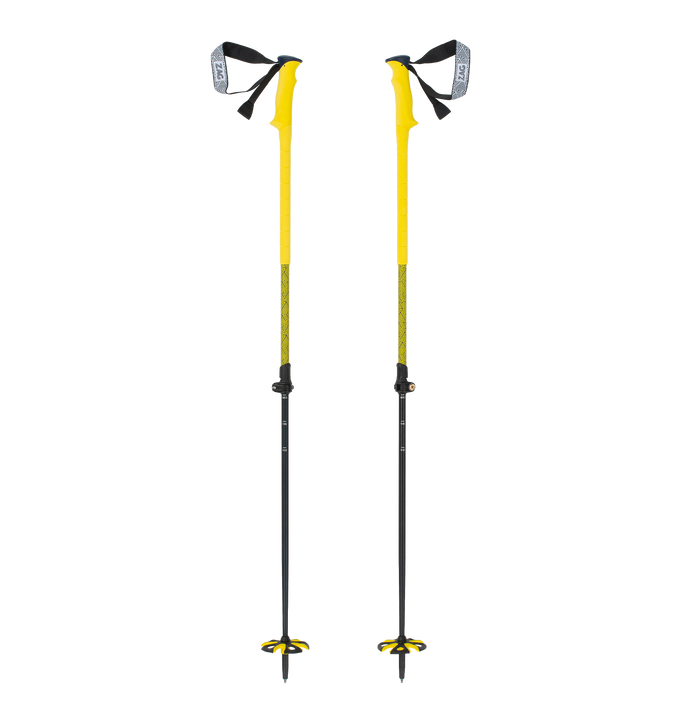
The locking system is the critical point. A lock that slips in the middle of an ascent means a Pole that telescopes under pressure and becomes useless. External lever systems (clip-type) offer superior clamping force and reliability compared to internal screw systems, and allow for quick adjustment while wearing gloves.
The fixed- Pole
Lighter, stiffer, and more direct in power transfer. A fixed- Pole e has no locking mechanism; therefore, it has no mechanical weak points. It is ideal for freeriding and on-piste skiing, where the length does not need to be adjusted throughout the day. However, it does not fold: it cannot be shortened for steep ascents or stowed in a pack for rock-climbing sections.
For ski- Touring, fixed- Pole s are only a good option if you mainly do downhill skiing and very little technical uphill climbing. For everything else, telescopic poles are the right choice.
Selection Criteria
Weight
When Touring skiing, you plant your Pole thousands of times a day. Every extra gram adds up with each movement. A high-performance ski Pole from Touring weighs between 200 and 280 g per unit. Above 300 g, you’ll notice the difference on long runs. In pure freeride, weight is less of a factor; durability takes precedence.
Material
Aluminum. The most commonmaterial . Sturdy, reliable, and repairable. An aluminum Pole that takes a hit will bend; it won’t snap cleanly. This is an advantage in the field: a bent Pole remains usable, whereas a broken Pole does not. Slightly heavier than carbon with equivalent stiffness.
Carbon. Lighter and stiffer than aluminum. Power transfer is more direct, and the feel is sharper. The downside: in the event of a violent impact, carbon breaks without warning, whereas aluminum deforms. Carbon is suitable for riders who prioritize weight and avoid terrain where the Poles takes a beating.
The grip
On climbs, your hands sweat. On descents, they freeze. The handle must handle both. EVA foam handles offer a good balance: reliable grip whether bare-handed or with gloves, moisture absorption, and long-lasting comfort. Some handles feature a lower extension (an elongated grip) that allows you to grip the Pole lower down during traverses without changing the adjustment.
The Strap
Often overlooked, the strap significantly affects the quality of propulsion. A good strap transfers the pushing force from the wrist to the Pole without squeezing the hand. In Touring, this is essential: over thousands of steps, a hand that’s constantly gripping tires much faster than one that’s pushing through a properly adjusted strap.
Safety is also a factor. A wrist strap that doesn’t release in the event of a fall can cause twisting of the wrist or shoulder. Quick-release systems (such as magnetic or safety clip types) free the wrist in the event of abnormal stress.
The base plate
The base plate is the disc at the bottom of the Pole that prevents it from sinking into the snow. In hard snow and on groomed trails, a small base plate is sufficient. In powder and soft snow, a wide base plate (70 mm or wider) prevents the Pole from disappearing with each plant. For Touring , and freeriding, opt for wide base plates.
Length
The general rule for a fixed Pole : your elbow should form a 90° angle when you hold the Pole planted in front of you, tip pointing toward the ground. In practice, most adult skiers fall between 110 and 130 cm. For a telescopic Pole , the adjustment range generally covers these sizes; the advantage is being able to adjust it based on the terrain.
ZAG'S " Poles "
Two models, two uses. Each designed with the same high standards as our skis: a “ Pole ” must be just as precise in its function as the ski it accompanies. The NORTH VARIO for the “ Touring.” The SOUTH for freeriding.

NORTH VARIO: The Pole from Touring
The NORTH VARIO is a two-piece telescopic Pole designed for ski Touring. Weighing just 245 g, it’s a lightweight companion on long climbs. The Z LOCK locking system with an external lever ensures a strong grip and quick adjustment, even while wearing gloves. Ergonomic EVA foam grips and Z SAFE wrist straps with a safety release mechanism.
WHO IT’S FOR: the ski tourer who wants a lightweight, reliable, and adjustable Pole for any type of route—from short outings to long tours.

SOUTH: The freeride " Pole "
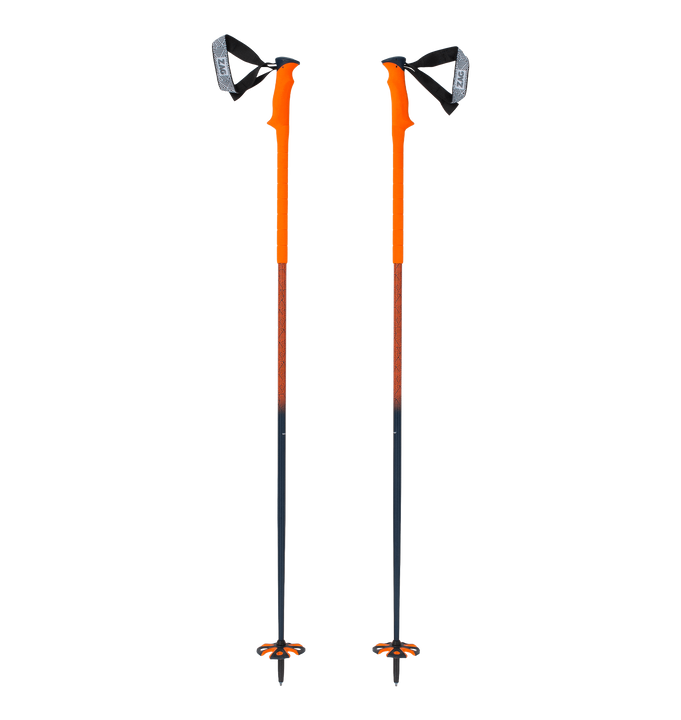
The SOUTH is a minimalist, ultra-light fixed- Pole : 200 g for the 120 cm size. No mechanism, no compromises. Comfortable EVA grips, Z SAFE System straps, and wide baskets designed for powder. Available in fixed lengths from 110 to 130 cm in 5-cm increments.
WHO IT’S FOR: freeriders and on-piste skiers who don’t need length adjustments and want the simplest, lightest- Pole possible.
Which " Pole " for which activity?
If you’re into ski Touring, the choice is simple: a telescopic Pole . The ability to adjust the length between the ascent, the traverse, and the descent isn’t just a convenience—it’s a necessity. The NORTH VARIO is designed for exactly that.
If you’re freeriding at a resort—using the lifts and focusing solely on the descent—a fixed-length Pole will do the job. It’s lighter, stiffer, and more responsive. The SOUTH is designed for this purpose.
If you’re into freerando (a little climbing, a lot of descending), a telescopic fork remains the best choice. Even a short climb requires an adjustable Pole as soon as the slope changes.
→ Collection Poles
→ Complete Guide to Skiing Touring
→ Equipment Collection
The Essentials
A good Pole won’t change your day. But a bad Pole can ruin it. In Touring, it’s the tool that propels you forward. In freeride, it’s the point of contact that connects your movement to the terrain. The right choice comes down to three criteria: weight, lock reliability (if telescopic), and grip comfort. Everything else is secondary.