Pakistan by Road


Traveling by Road Through Pakistan: From the Écrins to Trango—Six Months of Travel, Mountains, and Skiing.
23,000 km, a truck, skis, and a dream as solid as granite: from the Caucasus to the Pamir Mountains, then to the Karakoram—the story of a journey where the journey itself became the destination.
Leave.
It all starts with a dream: the Trango Towers, their granite cliffs massive enough to intimidate us and stir the hearts of us mountaineers and climbers. The classic scenario is familiar: plane, base camp, waiting for a window of opportunity, the attempt, and then back to everyday life. A great adventure in itself, but something felt off about that short flight to a distant mountain range. What lies between the Écrins and Trango?
So we set off overland by truck for six months. It wasn’t just about reaching the Karakoram, but about skiing in the Caucasus, the Fann Mountains, and the Pamirs, and climbing in Kyrgyzstan:about using our full range of mountaineering gear as the seasons dictated, and experiencing firsthand the distance between here and there.

Georgia: Skiing with a view.
We made our way to Georgia in 6 days and 45 hours of driving. The first administrative hurdle: the Russian transit visa, which required us to make three round trips to Tbilisi, punctuating our visits to the Caucasus Mountains.
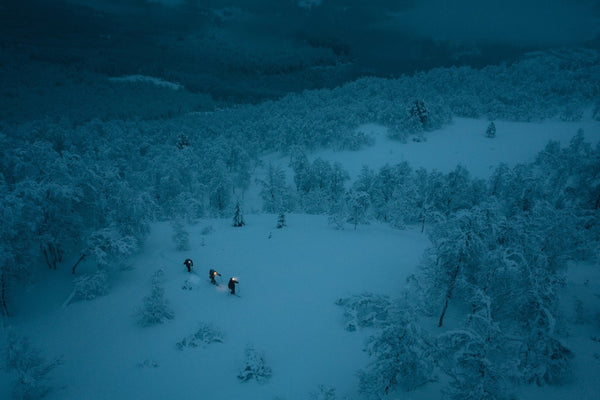
We arrived in the Kazbegi mountain range—three hours from the capital— with no information, knowing only that there were snow-capped mountains there. We’d later learn that a ski guidebook exists. It didn’t matter: in these vast, treeless mountains, it’s easy to navigate by sight, and improvising proved successful almost every time. We went on one outing after another in incredible powder conditions, with Mount Kazbegi as our backdrop, then headed back down to sleep in the van, which sometimes endured nights as cold as -20 . Everywhere we went, we were warmly welcomed. A forest ranger, happy to have some company, invited us over for a meal and would never understand why we preferred our van to his camp beds.
After a second visit to the embassy, we headed west toward Upper Svaneti and its stone towers attached to every house, at the foot of Ushba, Shkhara, and Tetnuldi. Here, the scale changes: to reach the high mountains, a tent becomes essential. In early April, the suddenly spring-like conditions—what a stroke of luck!—allowed us to tackle the south face of Ushba. From the pass, the view plunges down toward the Russian Caucasus and Mount Elbrus. We set off alone up this steep, surprisingly stable slope, then ski through the seracs of the glacier. An experience as beautiful as it was unexpected. As for Shkhara, it denied us access to its impressive banana-shaped couloir in the middle of a steep face, due to a lack of snow firmly bonded to the ice. You can’t ask for too much!
All that remains is to cross Russia, Chechnya, and Dagestan—a three-day journey—and to discover that the welcome there is far warmer than one might imagine from listening only to the media and the fear they instill in people’s minds.


Pamir: backcountry skiing.
On the other side of the Caucasus, you truly enter Asia. The border crossings become part of the journey (it takes 4 hours to get through, if you’re lucky), followed by 2,500 km of Kazakh steppes and desert. In Tajikistan, Afghanistan is just across a river that the road runs alongside for kilometers, and the people of the Pamir rush to the roadside to invite us in for tea.
On the skiing front, our luck continues. A beautiful run down the slopes of Chimtarga—despite having to turn back at 5,100 meters just before the summit—in the Fann Mountains north of Dushanbe, followed by an immersion in the vastness of the Pamir. Here, the mountains are in their raw, untouched state, and the possibilities for first ascents seem endless. In late April, the snow is far from the valley: we have to hike 20 km carrying all our gear for five days, without porters or mules. The villagers down below have a hard time imagining what we’re going to do up there, and we prefer not to tell them too much about it, for fear of worrying them. The reward:the first ski ascent of Peak Patkhor, 6,083 m, via its southwest couloir. Jackpot!

At the end of the road.
Next came China, with its border controls and an 11-day wait for a Pakistani visa, followed by Pakistan and the Hunza Valley. After 12,500 km and 14 countries, we had indeed achieved our goal: in early June, we climbed “Eternal Flame” on Trango Tower, four months after setting out. But that’s another story.
The path.
Traveling by road is sometimes a hassle, sometimes a blessing. It means accepting long hours on the road and waiting at borders; it means accepting that it will take—and require—more time. But it’s also a treasure we didn’t expect at the start: we didn’t just pass through countries and cram one activity after another into our schedule. The positive energy with which everyone we met seems to approach life—even while living on next to nothing— is a life lesson we’ll have to try to remember once we’re back home. Isn’t traveling through these countries and realizing both the beauty of the world and that of our own country upon returning a small antidote to the fear of the unknown? Without even trying, our relationship with the mountains has shifted. As we traveled, this realization became clear. Modern mountaineering does everything it can to reduce uncertainty. Yet isn’t uncertainty at the very heart of mountaineering? The philosopher Hartmut Rosa speaks of “making the world unavailable” as an antidote to a world that our societies want to make ever more controllable, more accessible—right here, right now. If mountaineering—or skiing— is an allegory for anything, it is undoubtedly for the useless. Yet isn’t the useless highly necessary in a world that seeks to make everything profitable and optimize everything? What draws us to the mountains isn’t the highest, the fastest, or the farthest—and therefore the most controllable—but rather beauty, sharing, mutual support, and time standing still.
Start over?
Sure. But first, let it sink in— don’t rush into one adventure after another too quickly. Then, definitely keep imagining journeys and connections—by truck or boat, and on skis—but above all, a human adventure, an immersion. Draw lines on the map—aesthetic ones—otherwise, what’s the point! Perhaps reimagining our vision of the mountains begins right there, without a set plan: asking ourselves what we’re looking for up there, taking the time to consider how we want to get there, and letting the journey surprise us.
Some facts:
- A 23,000-kilometer round trip in a non-4x4 Ducato L1H3.
- We've stopped counting the number of borders.
- Skiing down the south face of Ushba in Georgia from the South Pass.
- Skiing down the SE face from the shoulder (5,100 m) of Chimtarga in Tajikistan, in the Fann Mountains.
- First ski descent of Peak Patkhor (6,083 m) via the SW couloir in Tajikistan, Pamir.
- Climb of Eternal Flame on Trango Tower (6,239 m).
- Kyrgyzstan, Aksu Valley, ascent of the Perestroïcrack route on Slesova Peak (4,240 m)